Published
The short answer
Baltic pine is a trade name for Scots pine (Pinus sylvestris), a northern European softwood; Norway spruce is sold as white Baltic pine. It’s common in older Adelaide villas and cottages as tongue-and-groove boards on a suspended timber floor. It’s soft, so it dents and wears, and termites and borers attack it. Damaged boards are replaced with recycled boards of the same timber, width and thickness, and sanding should be light, because each full sand thins the boards. A floor that sags or bounces points to the bearers, joists or dwarf walls underneath, which is structural work. Repairing floorboards is licensed building work in SA.
What Baltic pine is, and why Adelaide villas have it
WoodSolutions, the national timber industry’s information site, lists “Baltic pine” among the other names for Scots pine, along with red deal and Riga pine: a softwood “originating from northern Europe and Asia” used for “general construction, flooring, paneling and interior joinery”. Norway spruce (Picea abies) is sold as Baltic white pine or white deal.
SA’s heritage technical note on older buildings (2008) names Baltic pine, with kauri and radiata, among “the more common timbers” in old buildings, and says the most common floor in those buildings is “the suspended timber floor”: floorboards on a timber frame, clear of the ground. Baltic pine boards are common in older Adelaide villas and cottages. NSW heritage guidance (interstate) adds that tongue-and-groove floorboards “were most often milled from softwoods”, Baltic pine among them.
Scots pine heartwood is yellow-brown to reddish brown, the sapwood creamy white or pale yellow, and the growth rings are “prominently marked by the darker, denser summerwood”. The wood is resinous and of low durability. On WoodSolutions’ hardness ratings for seasoned timber, it’s about as hard as radiata pine and, by our arithmetic, a little over a third as hard as jarrah, so a Baltic pine floor dents and wears more easily than a hardwood one.
Matching and replacing Baltic pine boards
Repairs match the floor that’s there. SA heritage guidance says “Wherever possible, retain original floors” and to “try to match the original timber species and board sizes” (DEW, Alterations and Additions, 1997), and the NSW sheet says replacement boards “should be of the same timber and section as the existing”. No official source gives a standard size for old Adelaide boards, so measure the width and thickness of yours.
Keep as much of the old floor as you can. The NSW sheet says to limit repairs and replacement “to those boards which are structurally inadequate or hazardous”, and that the aim is workmanlike repairs, not a floor that looks new. We found no Adelaide timber or salvage yard publishing a recycled Baltic pine price we could check on 28 October 2026, so ask whether matching boards are in the quote.
A repair is priced on how many boards need replacing, whether matching boards have to be found, and what turns up underneath once boards come up. Published South Australian prices for board replacement and squeak repairs are on the floorboard repairs page.
Squeaks, gaps and cupping in Baltic pine floors
SA’s heritage technical note lists the warning signs in an old suspended floor: cupped boards, squeaks under foot, boards that bend or fail, a sagging or arching surface, and bounce.
Squeaky floorboards
Squeaks mean the boards are moving at their joints, generally from long-term shrinkage, drying out after being damp, or loose nails. The note’s first remedy is puffing talcum powder into the joint, then re-nailing that section of floor. If the boards bend because they’re too thin, from heavy sanding or thin original boards, it says to get professional advice.
Cupped boards
Boards that curl up at the edges show that damp under the floor has made their undersides swell. Fix the sub-floor cause first, and don’t sand the floor level: the note says that “will permanently damage the floor”. Once the tongue-and-groove joint weakens and starts to split away, the floor is “damaged beyond repair”. The kerosene and re-nailing method for cupped boards should only be done by a trained professional.
Split, lifted and patched boards
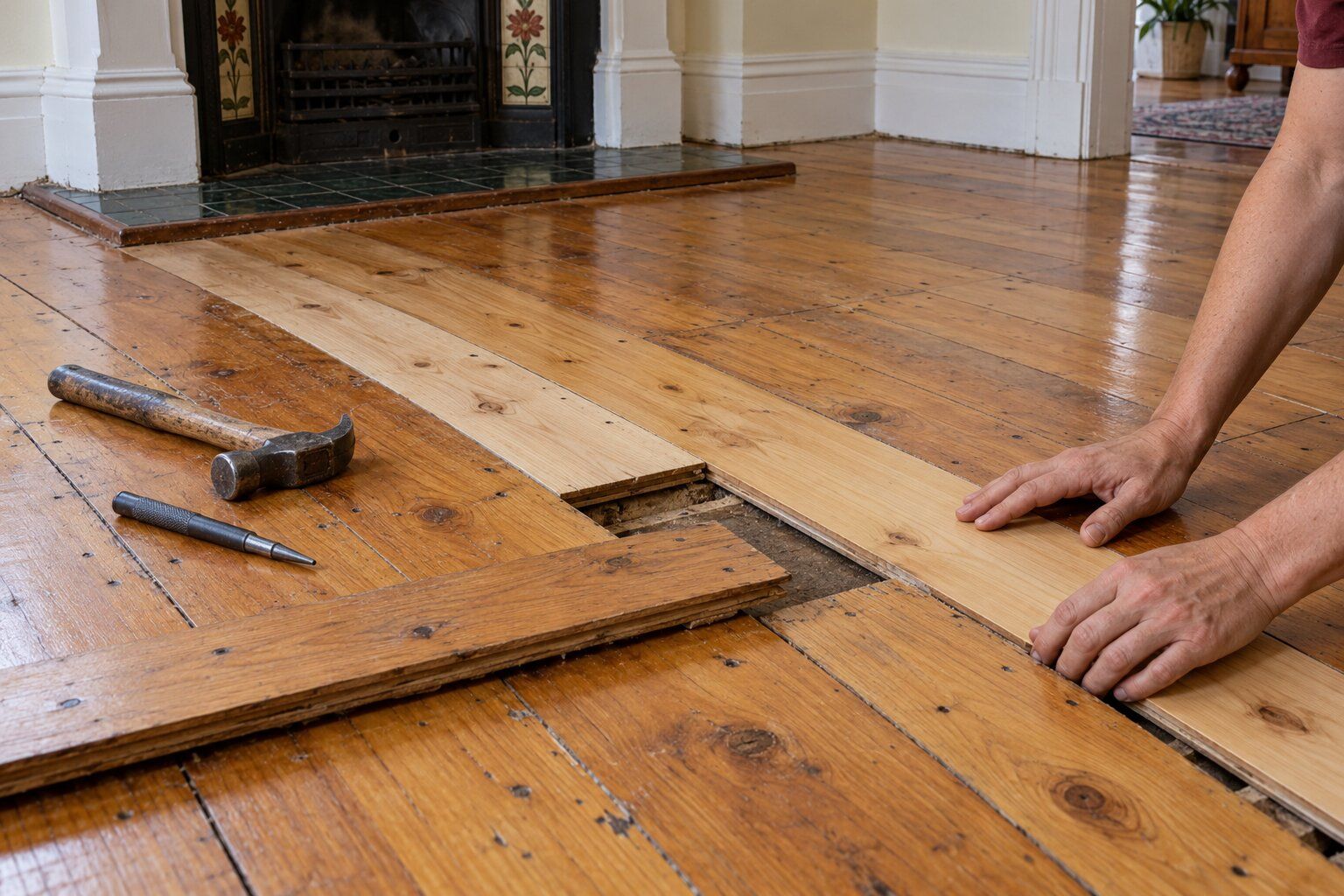
A board split along its tongue, or a gap left where a wall, hearth or heater has come out, is filled with matching boards. Where the floor bounces or sags across a room rather than at one board, look at the frame underneath first.
Termites, borers and sub-floor damp in stone villas
Termites
SA’s heritage technical note says pine, Baltic included, is “favourite termite fodder”, unlike naturally resistant timbers such as native pine (Callitris). If you find shelter tubes, don’t break into them: that can put the colony into “shut down” mode and make treatment harder. The note suggests checking for termites and borers at least every 12 months and calling a qualified pest controller if there’s activity.
Borers
The furniture beetle “has a liking for old softwoods”, Baltic pine included, in cool, dark, humid places, and a heavy attack can weaken load-bearing timber to the point of collapse. WoodSolutions says Scots pine is not susceptible to lyctid borer.
Sub-floor ventilation
The note says the most important thing for a suspended timber floor is the moisture under it. Too little ventilation keeps the soil and air damp; too much can speed up salt attack on the masonry under the floor; “Good cross-ventilation is the aim, without dead spots.” Keep the outside vents clear of rubbish and plants, clear out timber offcuts, which attract termites, and check pipes for leaks or sweating.
Rising damp in stone and brick villas
Norwood Payneham & St Peters council says rising damp is “a common problem in Victorian and Edwardian houses” in its area, and that ground and paving should sit below the original damp-proof course, ideally with at least 100 mm of wall showing below a tar-sand course (fact sheet). DEW says concrete slabs laid on fill can bridge the damp course, “one of the most common causes of rising damp in internal walls”, and can block sub-floor ventilation, encouraging dampness, rot and termites in timber floors nearby. On a villa, the front verandah base is part of this: see the bullnose verandah guide.
Sanding and finishing Baltic pine flooring
SA’s heritage technical note calls modern polyurethane finishes “unsuitable for floors in historic buildings” where the aim is to protect the floor and extend its life. The first sanding back to clean wood “significantly reduces the thickness and structural capacity of the floorboards”, especially if they’re slightly cupped, and once the finish wears through, the whole floor has to be re-sanded before it can be recoated. The note’s advice is “light sanding with a hand-held machine, following the contours of the floor”, and traditional finishes such as waxes, japans and varnishes, which give “a renewable wearing surface”.
Old paint is the other hazard. The Commonwealth’s Lead Alert guide (5th edition, 2016) says homes built before 1970 are most at risk of lead paint, shows lead dust “between floor boards” and “on joists and bearers”, and says “Do not dry sand”. So old paint near the floor, such as on skirtings, and dust between the boards may contain lead.
In a house built before the mid-1980s, asbestos.sa.gov.au says to check for asbestos before repairs or renovation. See the asbestos guide.
Bearers, joists and stumps: when a floor repair is structural
Under the boards, the sub-floor is “the system of joists, bearers and dwarf walls which supports the floor clear of the ground” (SA heritage Technical Note 3.1). In a stone villa the frame usually rests on masonry dwarf walls rather than stumps. The note lists the disintegration of dwarf walls, or the ledge of the main walls, from salt attack among the causes of a sagging or weak floor, because it leaves bearers or joists without support.
Replacing bearers, joists, dwarf walls or stumps is structural work, outside the carpentry quoted here, so a floor that bounces or sags across a room needs its frame looked at before any boards are replaced. Board-level repairs suit a floor whose frame is sound.
Floorboard repairs are licensed work in SA
Repairing a floor is building work under SA’s Building Work Contractors Act 1995, with no dollar threshold, and Consumer and Business Services includes “the installation and repair of timber flooring and floor systems” in its carpentry licence scope. So the work is done by a licensed contractor whose licence covers it. See how to check a licence.
Questions about baltic pine floorboards
What’s the difference between red and white Baltic pine?
They’re different trees. WoodSolutions gives a seasoned density of 560 kg/m³ for Scots pine (red Baltic) and 470 kg/m³ for Norway spruce (white Baltic), and rates the spruce softer.
Will the gaps between my floorboards close up?
They may. NSW heritage guidance (an interstate source) says gaps “may reduce in size during the next period of wet weather”, and warns against replacing too many boards because of a few gaps.
Do borer holes mean the floor needs treating?
Not always. SA’s heritage technical note says emergence holes and frass “may date back to a long-ceased attack”, so unnecessary treatment and expense can be avoided. Have the floor inspected before paying for treatment.
Is it safe to go under an old floor?
Take care. SA’s heritage technical note warns that sub-floor spaces “may contain residual termite sprays such as organochlorines or DDT”, and to wear protective clothing if you go in.
Can an access hatch be cut into the floor?
In a heritage building, SA’s technical note says to ask a heritage adviser about “the best location and method before cutting floors”. Several Adelaide councils offer free heritage advice, listed in the bullnose verandah guide.
Does replacing floorboards need council approval in SA?
A like-for-like repair that demolishes nothing and doesn’t harm the building’s structural soundness can fall outside “development” under Schedule 4 clause 4(4) of SA’s planning regulations. That clause doesn’t apply at a local heritage place, and no Schedule 4 exclusion applies at a State heritage place (regulation 3C(3)), so ask the council first there. Changing the floor structure is development.
Where this information comes from
The rules and guidance on this page come from these published pages, checked on 28 October 2026.
- WoodSolutions: Scots pine · National timber industry information site, species profile, undated
- WoodSolutions: Norway spruce · National timber industry information site, species profile, undated
- WoodSolutions: radiata pine · National timber industry information site, species profile (hardness comparison), undated
- WoodSolutions: jarrah · National timber industry information site, species profile (hardness comparison), undated
- Maintenance and repair of older buildings in South Australia (Technical Note 3.1) · SA Government (Department for Environment and Heritage) with Adelaide City Council, July 2008, revised September 2008: technical guidance only
- Heritage guideline: alterations and additions · SA Government (State Heritage Branch with the City of Adelaide), October 1997: technical guidance only
- NSW Heritage Office: repair of tongue and groove floorboards (information sheet 5.4) · Interstate government (NSW) heritage technical sheet, 2005: repair method only
- Norwood Payneham & St Peters: rising damp and salt attack · Adelaide council heritage fact sheet, undated
- Lead Alert: the six step guide to painting your home (5th edition) · Australian Government guide, 2016
- asbestos.sa.gov.au: homeowners · SA Government asbestos information site (SafeWork SA, EPA SA, SA Health and others)
- The Quote Yard: floorboard repair and replacement services SA 2026 · Quote-comparison marketplace, South Australian price guide, published 5 October 2026
- Planning, Development and Infrastructure (General) Regulations 2017, Schedule 4 · South Australian regulations: Schedule 4 cl 4 (exempt decks, pergolas, fences, sheds, retaining walls)
- Building Work Contractors Act 1995 (SA) · South Australian legislation: ss 3, 6, 28–36, 47A–47D, 49 and 50
- CBS: building work supervisor standard registration conditions · SA Government, Consumer and Business Services: the licence categories (carpentry, decks, fencing, windows and doors)